Monday, April 30, 2012

Graduation Recitals

 I am so excited to announce that this month three of my students graduated from Suzuki Piano Book 1! This is a very exciting step for me since becoming an independent teacher in 2010 and it shows that my students and their parents are willing to work hard, listen to their CD, and practice daily... or close to it!

 Graduation Recitals, as far as I know, are another unique part of the Suzuki Method and go hand-in-hand with daily review. In most traditional methods children perform once or twice a year on group recitals, and when they finish a book they simply move on to the next one. At least, that's how it went for me when I was a child. Instead, when my students near the end of a book we also go back to the beginning to polish every single song. Once everything is easy and ready, the student performs all of the songs in the book in order for whomever they decide to invite. Graduation Recitals are a celebration of what the student has worked so hard to achieve and a chance to 'show off' for family and friends. Then it's to a new book and, best of all, a new CD.


 Congratulations to Madeline, Zach and Zoe!


Sunday, February 19, 2012

A note from a Suzuki parent...

 ... on listening!


 Listening - I am a firm optimist.  I believe it when someone says that if you follow a recipe you will get the expected result.  When I first learned that listening to the music made an enormous difference in how a child learned to play the piano, I was willing to give it a try.  We listened to our Suzuki piano music daily and sure enough she learned to play the first songs very easily.  The melody was the first thing she imitated, but that was quickly followed with the "dynamics."  The most impressive aspect of this for me, that has reinforced my commitment to daily listening to the music, occurred after a summer of traveling.  We traveled for six weeks and my daughter did not practice at all during that time, as we were camping in national parks all over the West.  I was nervous coming back to lessons - I worried, "How much did she forget?"  But, sure enough, our almost-daily listening  kept those tunes in her head and it was short work to get her fingers accurately back on those keys.  Now her songs are much longer, but that regular listening makes learning so much easier.  She can break down and hear in her head exactly what the song is supposed to sound like.  It is like reminding her of something she already knows, much like increasing your child's writing and spelling abilities by exposing her to rich vocabulary in excellent stories.  Listening and doing seem to go hand in hand.

Friday, February 17, 2012

Listening: the determiner of success

 If you refer back to my "Suzuki vs. Traditional" post you'll see that the first step in the Mother-Tongue Method is listening. I cannot express how important this step is in the natural learning process of your child, especially when using the Suzuki Method. Here are a few simple reasons why and some examples of how listening ensures success.

  Listening ensures success through continual progress. Have you or your children ever taken dance classes? I never have, but I know that dance instructors don't have their students read descriptions of steps and sequences in order to teach them to dance. They have their students watch and imitate. The same goes for any type of music. As an accomplished musician you should always know how to count and read music, but it's definitely easier to grasp a complex rhythm, such as are used in popular music today, when you've heard it! Children are sponges, they imitate what they hear and see, both good and bad. If my students are listening to their CD on a daily basis then I can assure you that their progress will be consistent. I would even go so far as to say that listening to the CD is more important than practicing!

Listening ensures success in new material. When starting a new song with one of my students, I can always tell if they've been listening to the CD at home on a daily basis. Students who have been listening pick up the melodies of new songs effortlessly, usually with just a few tips from me such as which fingers to use and what note to start on. This is because the direction of the melodies have been in their ears for months. They know what's coming next.

 Listening ensures success with review. A couple of summers ago the mother of one of my students was worried that their extended summer vacation, which would include a lot of camping but no access to a piano, would send her and her daughter backwards in the hard fought progress they had seen the previous year. I challenged them to listen to the CD as much as possible while away, and whenever they had a piano to only focus on review. They came back in the fall not having lost any progress at all!

 Listening prepares younger siblings for success. I love teaching families of two or more because everything seems to be easier for the second sibling. My favorite example of this was with a family whose son, Adam, started at the age of 5, and a year later their 4 year old daughter, Anna, started lessons. During that first year when Adam was taking lessons, Anna would eagerly come to lessons, not to play, not to see me, but to sit right by the piano with her dad and watch Adam's lessons. They told me she did the same thing at home while he was practicing. When Anna finally got her chance to take lessons she already knew how all of the songs sounded, how to sit in lessons and pay attention, and that practicing at home should happen every day. Every week she astounded me with how easily she learned new songs, how careful she was to have excellent technique, and how attentive she was in her lessons, all because of the year of listening she'd had prior to starting her own lessons.

 If you don't already listen to your Suzuki CD every day, I challenge you to do it for one week and look for changes in how your child practices.
 Some good places and times to listen are:
 - in the car,
 - in the morning while you're all getting ready for work or school,
 - while your child is doing homework,
 - at night while they're falling asleep.
 Try to make the listening active by asking your child:
 - "what song do you like best?"
 - "do you recognize any songs from the end of the CD?"
 - "which songs would you most like to learn?"

 I hope this has adequately emphasized the importance of listening. Please let me know if you have any questions or comments by contacting me at dunkirksuzuki@gmail.com.

 Happy listening!

Thursday, February 9, 2012

What do I do when my child doesn't want to practice?

 If you have children who are taking any type of music lessons, then I'm sure you've struggled with this problem. We all want children to enjoy learning and playing their instrument, so how do you get them to sit and practice without forcing them? Unfortunately, there's no one right answer, but here are some things that may help.

 - Recognize the problem as early as possible. If you notice that your child is becoming less and less enthralled with practicing at home, the more quickly you do something about it the fewer fights you'll have.

 - Talk to your child about the situation. Why is practicing not as enjoyable? They'll usually have a good answer, like "it's too hard and frustrating." If this is the case, they may need some encouragement or to be shown their progress in the last few weeks by looking through old practice sheets. If boredom is a factor, then some things may need changed such as time of day, order of practice songs or to be pushed more in lessons, which brings up the next point.

 - Talk to your teacher about the situation. No, teachers don't like to hear that their students aren't happy about practicing at home, but even more, students don't like their teachers to hear that they're not happy about practicing at home. I can always be the bad guy in a situation like this because of the relationship I've built with my students.
 There are two drastic situations that I can think of. The firts was with a boy who was about 7 years old who refused to practice at home, and therefore was not progressing in lessons. His mom communicated this to me, and I talked to him about it. Unfortunately, the problems had begun quite a while before it had been brought to my attention so there were more reasons than I can even list. Eventually, I told the boy that by not practicing he was wasting his mom's money. It had never occurred to him that his mom paid for lessons because he had never seen her give me any money.
 The second situation was with a young girl who also fought practicing at home. This mom communicated very well with me by phone whenever they had a bad week and also discreetly told me about their practicing situation at home. I talked to the girl about it and suggested to her and her mom that the next time they had any problems at home to have the student call me to tell me why she didn't want to practice. I never got a call.

 - Make practicing fun. Young kids thrive on routine, but as they get older they need more variety to keep their attention. This is where you, the parent, get to be creative! It takes more effort on your part, but the outcome is well worth it. First consider what your child enjoys - competition, puzzles, games, rewards, praise, goals, etc. and use it to your advantage.
 Competition - compete with your child to see who can identify 7 different piano keys by letter or 7 different notes on a staff the fastest. Who can play "My Fair Lady" 5 times perfectly?

Beth identifies 7 different piano keys
 Puzzles - most of the songs in book 1 can be linked with each other by similar traits. See if your child can figure out the links. Here is one of many examples: starting with Mary Had a Little Lamb, "what other song starts on E?" Answer: French Children. Play French Children. "What other song has a 'funny animal' pattern in it?" Answer: Au Clair de la Lune. Play Au Clair. "What other song has an A in the RH melody?" Answer: London Bridge. Play London Bridge. "What other song has a G alberti?" Answers: Lightly Row, Long, Long Ago, Aunt Rhody. And so on.


 Games - you can incorporate any board game into a practice session, and you can make up other games specifically for practicing. Some games I use for review are picking from popsicle sticks with names of review songs on them, "going fishing" for review songs, and rolling dice with numbers correlating with the numbered songs in the book. To use a board game, simply attach sticky tack or tape to the game pieces so the board can be leaned onto the piano, and for every review song or repetition your child accomplishes, you each get a turn in the game.

Chutes and Ladders
 Rewards - there are many different levels of rewards that you can do for your child. Take your child's personality into careful consideration to know what will motivate most effectively. Young children may do better with immediate rewards while older children have the patience to earn towards bigger ones. A mom told me that they use things like a new bike, something they were going to buy for their child anyway, as a reward for practicing. You can use snacks or pennies during a practice session, sticker charts towards an ice-cream or pizza outing, or sticker charts towards something big at the end of the year, like tickets to an event, or a bike (or a puppy!)
 Praise - don't forget that children are constantly looking for your approval. If you're able to leave every practice session letting your child know that you're pleased with their accomplishments, or if it wasn't a great day, their efforts, this goes a long way in encouraging them.
 Goals - have immediate goals in practice session, like playing the melody of the new song perfectly twice, or playing all of French Children perfectly and slowly. Have short term goals like encouraging your child that once they've learned all of Lightly Row with alberti's then you get to move on to a new song. Have long term goals, like finishing Book 1 and doing a recital for friends and family, then moving on the Book 2! Always acknowledge when these goals have been accomplished, then set new ones.

 Visit this link for more great tips on helping your child effectively and happily practice at home: http://suzukiassociation.org/news/i-love-to-practice/.

Wednesday, February 1, 2012

The Joy of Parent Lessons

 If you've been following my posts, then you've already learned that parent lessons are one of the steps to prepare your child for lessons and that this is one distinction between traditional and Suzuki lessons. To be honest, when I first started teaching I was terrified of working with my students' parents. In my continually growing experience, I've learned that parent lessons are not only extremely important, but they're fun too! They give me a chance to get to know you, hear you describe your children, and build a bond with you which makes future issues such as behavior in lessons, practice habits, unwillingness to practice, etc, easier to discuss and address.

 Here are some things we talk about in parent lessons:

 The Suzuki Philosophy - I don't believe there is any way this can be understood better than Shinichi Suzuki's slogan, "nurtured by love." We, teachers and parents, should always be aiming to educate first through love. Once you've learned what this means for you and your family, you can apply it to all aspects of parenting. "Discipline through love," "be an example through love," "advise in love," and the list could go on.

Shinichi Suzuki

 Posture and Technique - Of course to help your child at home, you must first understand the fundamentals of playing the instrument. Even if you've taken lessons in the past and know how to play, it is still important to understand the steps your child will take to learn and tips on how to fix problems at home.

 Developing Good Practice Habits - The question I most often hear is "how long should we be practicing at home?" Don't feel bad if you've asked me this! It is a good question because it brings up a very good point. Time doesn't matter, goals do.
 For a very young student, encouraging them to practice is usually not an issue. They're excited to repeat the new things they learned that week for you to see! Your goal is to lengthen their practice sessions by going as long as they can before they lose focus, then just one minute longer. This will naturally lengthen their attention span. Your goal is also to have as much of the practice session be positive as possible. Play games, let them pick their songs (this instills confidence), let them earn stickers, pennies, or candy(!) for accomplishing tricky repetitions, and do recitals for family members.
 For older students, the goal is to successfully finish their practice sheet from that week's lesson. Generally, if they're having a good practice day it won't take very long, which is great! If your child is tired from school and other activities, which is completely understandable, it may not be a great practice day. These days, you should do as much as you can together before your child gets frustrated, finish with a review song (again, to instill confidence) and be done. These steps will prevent practicing from becoming a chore, or something your child dreads each day.

 Positive Learning Environment - All of the things required for making good, daily practice habits also go along with creating a positive, home learning environment. I've had many parents comment to me that their child is much more focused in lessons with me than at home. There are many reasons for this and, unfortunately, the two biggest are something you cannot control: in a lesson your child is not at home and I am not you. There are things you can do to discourage distraction at home:
 - Turn off your phone,
 - Have your piano in a room away from the TV, computer, video games and toys,
 - Make sure your child is not hungry,
 - Have your child use the bathroom before each practice session,
 - Choose a time of day which is best for your child.
 Obviously, all of these things may not be possible for you, but try to do as many of these as possible.

Role as a Parent - One of the things that the Suzuki Method relies on is the Student-Parent-Teacher triangle. Our jobs as the teacher and parent are to be the foundation for the student through support, encouragement, and "nurturing through love."


 - Effective communication between the parents and teacher is important in this step to prevent bigger problems from occurring in the future. If you sense that your child is bored, not seeing success, not being pushed, being pushed too hard, or anything else, communicating this to me as soon as possible will help us both address the situation and hopefully prevent it from becoming a problem.
 - Presence in lessons, taking notes and asking questions during lessons are also very important in supporting your child at home. The more you understand about what your child is working on, the more you'll be able to help if they get stuck at home.
 - Praising your child for their accomplishments is one of the best ways you can encourage your child to persevere when they come across something difficult. I'm not advocating lying, saying they did well when they really did not, but you can always find something that is praiseworthy.


 I've had many parents eagerly take on the responsibility of learning the piano in order to help their children. If you've ever regretted quitting piano lessons when you were young, this is a great way for you to learn while encouraging your child!

Thursday, January 26, 2012

How do I get started?

It’s never too early to start your child’s musical training. If your child is 3 years old or older, believe it or not, you’re ready for lessons! Here are a few things you can do as a parent to prepare yourself and your child.

Exposure - Many parents think that if their child has not expressed interest in the piano or in music, that they may not enjoy taking lessons. This usually is not true! One of the Mother Tongue Method steps discussed in the "Suzuki vs. Traditional" post is Imitation. If music is something that you believe would be good for your child, then start by showing interest in it yourself and exposing your child to it.
 - Watch concerts on TV or go to them live,
 - Buy the instrument you'd like your child to play and start learning to play it,
 - Take your child to watch other children's lessons,
 - Talk about you and your child learning the instrument together.


Find a Teacher - If the Suzuki Method is something you may be interested in then you can go to http://suzukiassociation.org/teachers/teacherloc/ to find a teacher in your area. If you think a traditional approach would better suit you and your child, then you may be able to ask your child's school music teacher or contact a nearby college's music department. And, of course, you can contact me!

Start Listening - This goes along with exposure, but if you've chosen to use the Suzuki Method then it is never too early to start listening to the CD. You can ask any Suzuki family with multiple children and they'll agree that the younger children excel because of the extra listening they've been exposed to from their older siblings. Ask your teacher for a CD even before you schedule your first lesson.

Obtain an Instrument - Of course this depends on what instrument you have chosen for your child to study. Local music shops typically offer rental programs for many instruments, but check with your teacher before renting one to make sure it's the right size. A rental will probably be difficult to find for a piano, but you can look online, in the paper, or ask family members if they have a piano they're not using. Beginner students can start learning on a keyboard, but I encourage families to invest in a real piano at some point. Having a quality instrument for your child to play will also encourage them.

Observe Lessons - This a completely free way to get to know a teacher and learn a little bit about what you'll be doing. Children learn very well when immersed in a musical environment. You can also learn how lessons progress and what your role is as a parent.


Blake plays while his Mom and sisters observe

Schedule a lesson - You will need to think about when is best for your child to have a lesson. Young children do not typically learn well late at night or during nap time and older children may do better if their lessons are not the same day as other activities.


Parent Lessons - I typically ask that new parents participate in four parent lessons before their child begins lessons. These provide you with the necessary tools you will need to help your child succeed at home. We discuss things such as:
 - The Suzuki Philosophy,
 - Proper posture and technique,
 - Developing good practice habits,
 - Creating a positive learning environment,
 - Your role as a parent.

 I hope these steps make it seem easier to get your child started. If you have any questions about starting your child you can always contact me, Sandra Leary, at dunkirksuzuki@gmail.com, or call (716)270-7117.

Thursday, January 19, 2012

Suzuki vs. Traditional

 This topic is usually one of the first that I go through with my new students' parents since most adults who have taken lessons in the past were taught using a traditional method. The differences seem endless, but I will try to highlight the most obvious and important.

 Note-reading - In a traditional method the first thing a child will do is start learning how to read notes. While this is a vital part of music, the Suzuki method uses the Mother-Tongue Method. Dr. Shinichi Suzuki believed that if every child could learn to speak his/her native language fluently, then every child could learn to play music fluently using the same steps.

      Listening - infants develop their hearing while still in the womb at week 16 and typically start forming words around 12 months. The first assignment your child has as a Suzuki student is to listen to the Book 1 CD which plays all of the songs they will be learning.
     Imitating - children always imitate their parents, whether you want them to or not! In the Suzuki Method the parent starts by taking lessons and practicing at home, then when the parent is ready the child copies the parent in taking lessons and practicing.
    Repetition - children love to play the same games, watch the same shows, eat the same food, etc. We use that to our advantage by constantly repeating our review songs to solidify technique.
    Reading - after a child has successfully learned to speak, they will learn to read and write. Every Suzuki teacher starts note-reading at a slightly different time because it depends on the child's readiness, but I typically introduce note-reading at the end of Book 1 or beginning of Book 2.


Parental Involvement - When I was young my Mom dropped us off for our piano lessons (along with $.25 for candy!) and went to do her grocery shopping. It wasn't until I was in college that I finally let her sit in on a piano lesson. I so wish I could go back and have her at every lesson so that she could help me and guide me at home. Since the Suzuki method allows starting students very young, usually at 3 or 4 year old, it's impossible to expect a child that age to take the responsibility of practicing alone at home. Not only that, but it makes a huge difference in the child's success to have the parent involved. Parents, you don't have to know a thing about music to be able to help your children, although you will learn along with your child as you sit in the lessons. You provide stability, partnership, guidance, and fun in the practice sessions at home. Sometimes when your child gets frustrated with something, it helps them to see that you're puzzled by the same thing.


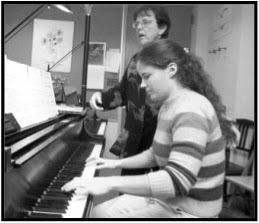
A piano lesson with Mrs. Phyllis East
Technique - It's not fair or accurate to say that all Suzuki students' technique surpass that of a traditional student, and proper technique is not our ultimate goal. However, it is a focal point from the very first lesson. I believe that the Suzuki method, since we start by looking at our hands instead of notes on a page, allows us to address hand position, tone, and musicality from the very beginning.


Repertoire - Most traditional teachers use an array of different method books, and once students reach a certain level they will skip around to find songs the student may enjoy, rather than songs specifically chosen to teach the next step. While this is not a hopeless way of learning, it can be difficult to see progress. The Suzuki method has graded repertoire, all chosen to teach a specific point in a specific order, much like the progression in grade school math. Another benefit to this is that beginner students get to hear more advanced students play the songs they will be learning in the future and are constantly inspired and motivated by them.


Teacher's Accreditation - Obviously, any pianist will reach a level in their musical education, whether they take lessons through High School, or go on for a college degree, which qualifies them to teach piano lessons. The Suzuki Association has taken it upon themselves to make sure that their teachers are not only accomplished performers, but also prepared teachers. To become a Suzuki Certified teacher you must pass an audition process before taking training in each individual book (7 books total for piano) in order to teach the material. If you are interested in taking Suzuki lessons, always make sure that the teacher you're considering is certified. Unfortunately, there are many teachers out there using the repertoire who have not had the training.


 I know this post has been lengthy, but I hope it has answered questions and sparked more interest for this amazing way of learning! My goal as a Suzuki teacher is to teach through love and enthusiasm, and develop a love for music in my students.